


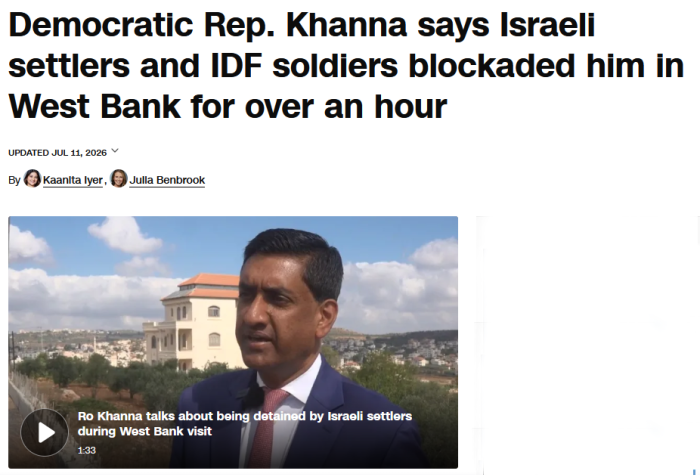
CNN (7/11/26): “The West Bank has seen a surge of settler violence—some with instances of Israeli soldiers standing idly by—in conjunction with the Israeli government rapidly expanding settlements throughout the territory.”
After US Rep. Ro Khanna (D-Calif.) was detained in the West Bank, first by Israeli settlers wielding US-made rifles, then by the IDF, his outrage was palpable.
“I see these young men brandishing M4s, circling, circling our vans, cursing us out in Hebrew and Arabic, which I didn’t understand, and filming us, laughing at us, wiping our windows while doing that, blockading us,” Khanna told CNN (7/11/26).
When IDF soldiers showed up, Khanna said, they took the side of the settlers:
And that’s when I got actually nervous and scared that there could be some incident.
Our security person goes and talks to the IDF soldiers and they said, “We don’t care that there’s an American in the car. We don’t care about a congressman. We don’t care what the American embassy is saying.”
Khanna was there, he told CNN, because he believed that “it is important for an American politician to have an uncurated, extensive look at the occupation through the eyes of Palestinians.”
As reported by the New York Times‘ Lisa Lerer (7/11/26), the key takeaway from this incident was not about settler or IDF violence and impunity, but that, as the subhead explained, “Where past US leaders toured the region to show support for Israel, today’s Democratic presidential aspirants are going to bolster their credentials as critics.”
And neither the Times nor the CNN report included the critical information that the settlers are funded by the Israeli government and armed by Israel’s military–refusing to connect the dots for readers about who was to blame for escalating West Bank violence and displacement.
Shifting blame for settler violence
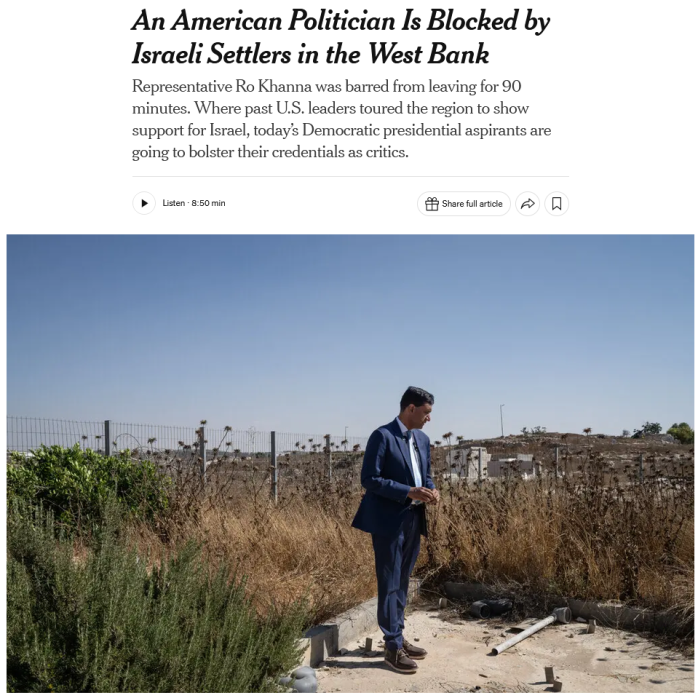
The New York Times (7/11/26) framed Rep. Ro Khanna as an “American Politician”—lumped with Rahm Emanuel as “presidential aspirants” who went to Israel/Palestine to “bolster their credentials as critics.”
Despite footage showing soldiers refusing to move—and the presence of a New York Times photographer, as noted by Lerer’s piece—both CNN and the Times included, with no pushback, IDF denials that soldiers blocked Khanna and his team. CNN reported an IDF statement that said, “The IDF soldiers operating in the area did not take part in blocking the road.” The Times paraphrased an IDF spokesperson saying that “troops were dispatched and reopened the road,” and reported that “the military disputed that its soldiers had participated in blocking the exit.”
The Times avoided explaining any causes of settler violence in the West Bank, with Lerer steering clear of identifying Israel’s culpability. Israel’s only fault seems to be that it hasn’t been paying attention, or for some reason hasn’t been able to rein its colonists in: “The responses of the Israeli authorities have generally ranged from unkept promises to address the problem, to blame shifting, to outright denial.”
That sentence was lifted verbatim from an earlier Times article (5/4/26) on settler violence by Natan Odenheimer, David M. Halbfinger and Fatima AbdulKarim.
The Times suggested that settler violence is driven by Hamas, not Israel:
Violent attacks by Israeli settlers on Palestinians in the West Bank have intensified since the Hamas-led attack on Israel on October 7, 2023, that set off the war in Gaza.
This accusation has become a key propaganda nugget designed to deflect blame for Israel’s actions in the West Bank, when in fact, as the Intercept (10/13/23) put it, Israeli Settlers “took advantage” of October 7 to attack Palestinians in the West Bank. Within a week, settlers and soldiers had killed 51 Palestinians and depopulated two villages in the West Bank. At the time, Middle East Monitor (10/11/23) also reported that far-right Security Minister Itamar Ben-Gvir was handing out 10,000 rifles.
‘A vehicle for violent settlers’
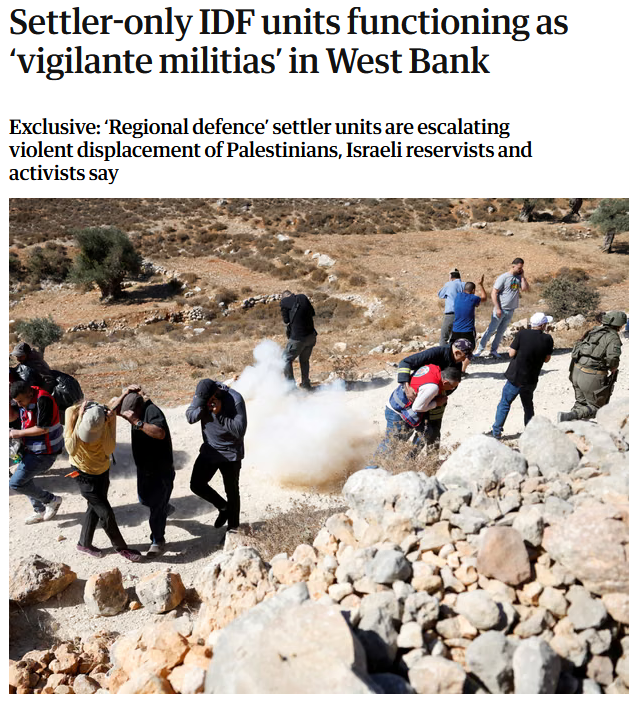
Yehuda Shaul (Guardian, 1/30/26): ““The settlers are the IDF, the IDF are settlers, there’s no pretence of a buffer.”
The British Guardian (1/30/26) was the rare establishment outlet that identified how after October 7, Israel’s army
has become a vehicle for violent settlers to escalate their campaign against Palestinians across the occupied West Bank, with reserve units drawn from settlements functioning as vigilante militias.
In October 2023, the paper noted, the state set up regional defense units, called hagmar:
The system handed weapons and authority to thousands of settlers, who formed military units in their own communities, with few checks on how these powers would be used. The state pays hagmar salaries, but in effect they operate in parallel to regular battalions.
While formally under the command of the IDF, a reservist explained to the Guardian that “on the ground they are given a free hand.”
A recent UN Human Rights Commission report (6/8/26) found that this fundamentally changed the situation in the West Bank:
The increasing participation of Israeli security forces in settler attacks amounts to a de facto collapse of the distinction between settlers and soldiers, which has heightened since thousands of settlers were recruited to rapid response units (kitot konenut) and “regional defence brigades” (hagmar), and thousands received gun licenses and were armed at the instruction of the Minister of National Security.
The report further accused the Israeli justice system of “contribut[ing] to impunity for settler violence.”
‘In conjunction with the Israeli government’
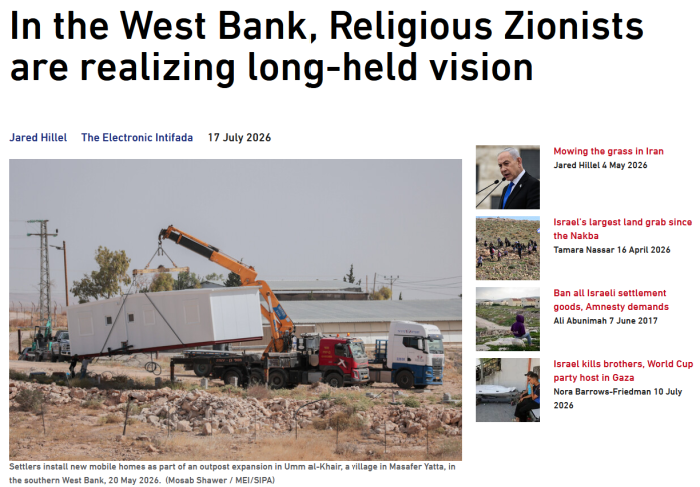
Electronic Intifada (7/17/26): “Since 2020, over 1,100 Palestinians in the West Bank—a quarter of them children—have been killed by soldiers and settlers. Not a single person has been charged in connection with any of these deaths.”
Electronic Intifada (7/17/26) traced the current leap in settler violence back even further, to Netanyahu’s government that came to power in December 2022, when far-right Finance Minister Bezalel Smotrich, himself a settler, was given “sweeping control over the West Bank.”
In the early months of 2023, the approval process for new settlements was fast-tracked, and has been accelerating ever since. In March 2026 alone, Israel’s security cabinet secretly approved 34 new settlements, and retroactively legalized 10 previously unauthorized outposts. As DW News (5/7/26) reported, “Such outposts, illegal under Israeli and international law, often receive state funding, infrastructure and protection.” Under the Netanyahu-led coalition, 102 settlements have now been “legalized.”
The CNN report (7/11/26) offered only a fragment of this reality, distancing the Israeli government from direct culpability:
The West Bank has seen a surge of settler violence—some with instances of Israeli soldiers standing idly by—in conjunction with the Israeli government rapidly expanding settlements throughout the territory.
‘Handful of kids’
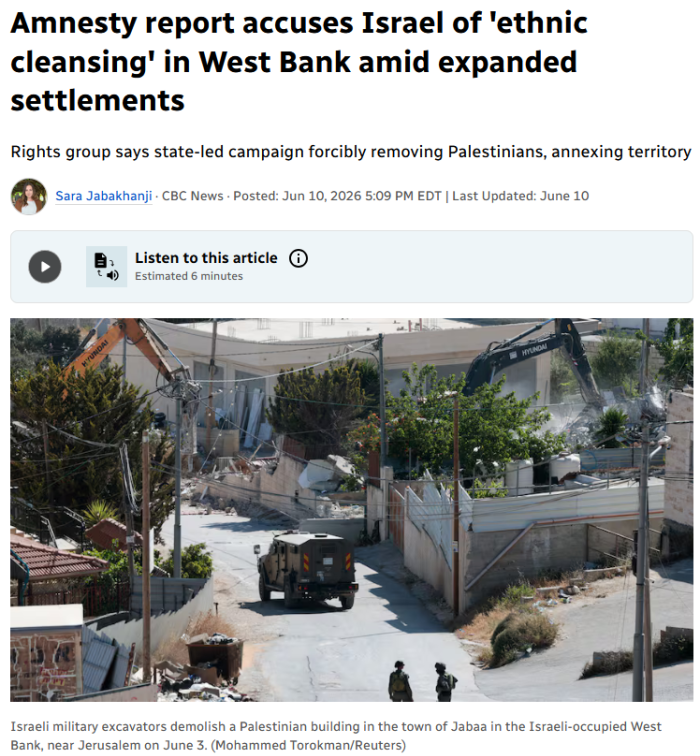
US corporate media did not find newsworthy an Amnesty International report (6/10/26; CBC, 6/10/26) accusing Israel of “ethnic cleansing.”
The tropes that deny, twist and mislead are being repeated in the New York Times’ rigid framing of its coverage about the West Bank. In its earlier report on settler violence (5/4/26), the paper repeated Netanyahu’s claim (Fox News, 12/30/25) that a “handful of kids” are responsible for the violence.
The Times went to lengths, consulting “experts” to confirm that the violence is coming from a small group of about 1,000 settlers, concluding: “All told, that is a small fraction of the roughly 700,000 Israelis living in West Bank settlements.”
It’s a claim Netanyahu has made repeatedly with little pushback in US media, arguing that violent settlers amount to “150 juvenile delinquents,” against whom “we apply the full measure of the law” (Meet the Press, 7/12/26). He repeated the juvenile delinquent assertion in an interview with Dana Bash on CNN (7/7/26).
As the Times and other establishment media follow the script that a small group of misdirected, mostly youthful settlers are launching attacks, West Bank settlers are playing an instrumental role in Israel’s expansionist policies. Amnesty International (6/10/26) accused Israel’s government of implementing “a state-led and -sponsored campaign that has resulted in the forcible displacement of Palestinians in the West Bank.” As the CBC (6/10/26) quoted Amnesty International secretary general Agnès Callamard:
Our report exposes that these abuses are not the result of a few “bad apples.” Settler violence is a core component of a state-sanctioned campaign of ethnic cleansing, central to maintaining Israel’s system of apartheid.
No US corporate media covered Amnesty International’s report.
Hiding the mechanisms
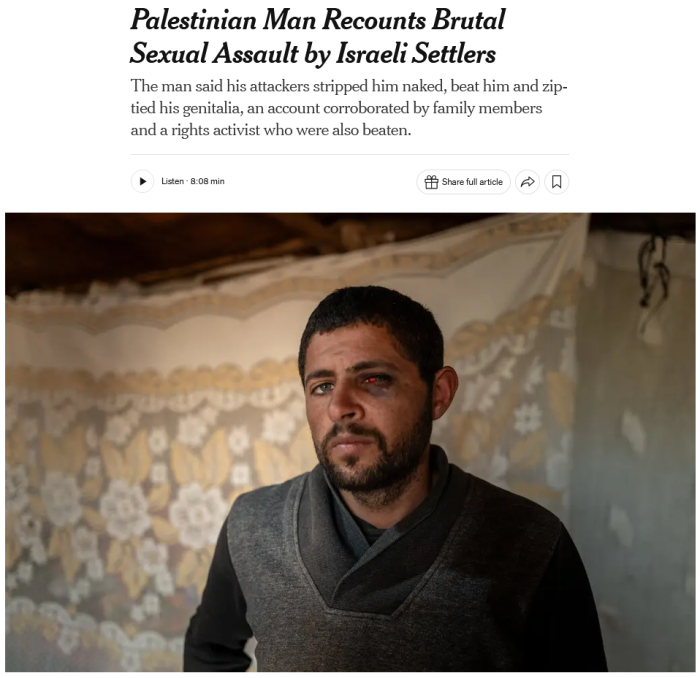
New York Times (3/18/26): “The Israeli police…opened an investigation into the attack in Khirbet Humsa but did not respond immediately to requests for comment.”
What is so demonstrably reprehensible about the reporting and framing of the New York Times coverage is the heart-wrenching way it (very) occasionally details the suffering of Palestinians, but the systemic mechanisms that result in such suffering are deliberately obscured, denied or simply not mentioned.
In a graphic recounting of a horrible assault on Suhaib Abualkebash and his family, when violent settlers attacked their Bedouin encampment, the Times‘ Halbfinger and AbdulKarim (3/18/26) reported, they “stripped him naked, beat him and zip-tied his genitalia, an account corroborated by family members and a rights activist who were also beaten.”
After many column inches of detail, one familiar phrase is offered as explanation: The violence “has intensified as Israeli attitudes toward Palestinians have hardened since the Hamas-led attack on southern Israel on October 7, 2023, and the war that ensued.” By hiding the mechanisms of state support and the broader picture of land annexation, and failing to identify war crimes such as ethnic cleansing, such reporting amounts to little more than a false claim to journalistic credibility (FAIR.org, 10/7/24).
‘Bolster their credentials as critics’
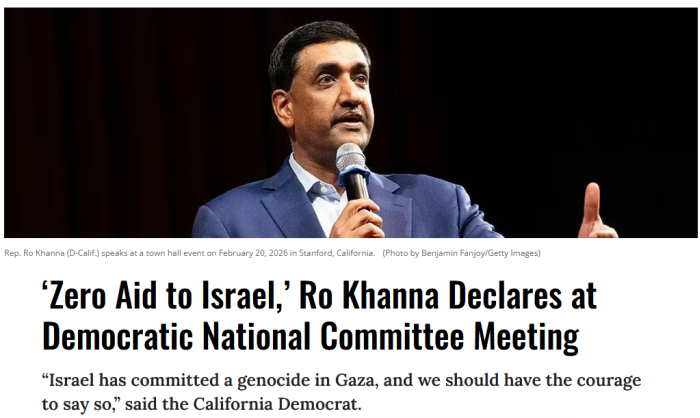
Ro Khanna (Common Dreams, 8/16/26): “If our party cannot stand for these principles, it will never convince a generation that watched the horrors of Gaza on their iPhones that we mean what we say about justice.”
The New York Times avoids truthful explanation of the West Bank by pivoting to electoral politics, in reporting that is equally flawed. Lerer wrote that as Khanna was “being blocked by settlers in the West Bank,” Rahm Emanuel “was speaking at Tel Aviv University.” Giving a talk within the safe confines of the University was hardly the same as being detained by violent settlers in the West Bank, especially considering the terrifying attacks two days later, when a CNN crew was forced to flee after settlers tried to slash their tires and smash their windshield (Middle East Eye, 7/11/26).
The Times headline (7/11/26) referred to Khanna as an “American Politician”—not a US lawmaker or legislator—implying his trip was more a campaign stunt meant for optics than an attempt at congressional oversight. The piece is peppered with language supporting this angle:
At a time when Israel is hemorrhaging support among Americans and particularly among Democrats, a tour of the West Bank is a new way for progressive politicians to signal their concern.
But where past Democratic leaders headed to the region to show their support, so far today’s Democratic presidential aspirants are going to bolster their credentials as critics.
While Khanna engages with the possibility of a presidential run, he hardly needs to bolster his “credentials as a critic.” He has been vocally critical of Israeli violence against Palestinians, calling it genocide; on July 15, he was one of 104 congressmembers that voted to Block the Bombs. He co-sponsored a congressional amendment with Thomas Massie (R–Ky.) to prevent the merger of technology and intelligence sharing between the US and Israeli militaries.
Nostalgia for past ‘sightseeing’ tours
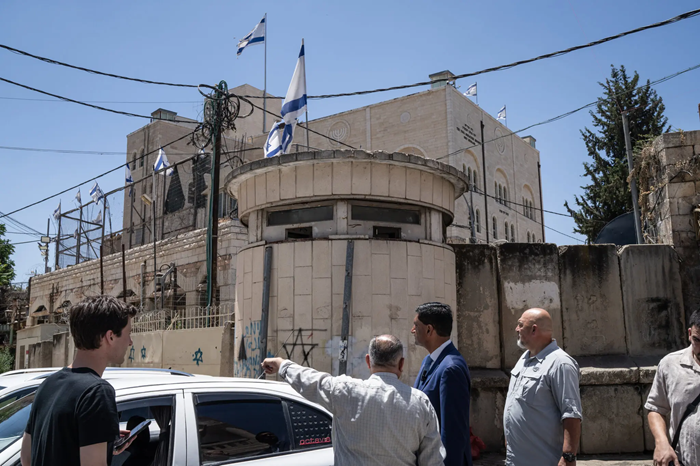
New York Times photo (by Samar Hazboun—7/11/26) of Ro Khanna’s tour of Hebron, which was conducted, as a former US ambassador to Israel complained to the Times, by people who “are probably not objective analysts.”
The New York Times made it clear that it doesn’t approve of Khanna going on what would be accurately referred to as a fact-finding mission to the West Bank.
Lerer recalled the bygone days when “potential presidential aspirants made pilgrimages to Israel in hopes of burnishing their foreign policy credentials.” Among other stops, politicians met with Israeli leaders, engaged in “sightseeing at the Western Wall” and would be taken to an Israeli city “damaged by Palestinian rocket fire”—to demonstrate how Israel was surrounded by hostile Arabs. According to the Times, the political goal was to “demonstrate their commitment to the United States’ special relationship with a longtime ally.”
But Khanna deliberately avoided an official Israeli-chaperoned tour, and eschewed government minders; the article noted that he called his visit “uncurated,” describing it as a “Palestinian-led” glimpse into the West Bank. He asserted, “No American would support this if they knew the details of what was going on here.”
The Times “balanced” Khanna’s claims with a quote from Daniel C. Kurtzer, a former US ambassador to Israel who chaperoned dignitaries to the country in the past: “He got an earful in the company of people who, I would say, are probably not objective analysts”—unlike, presumably, the propagandists who once led the “sightseeing” tours.
The ‘litmus test’
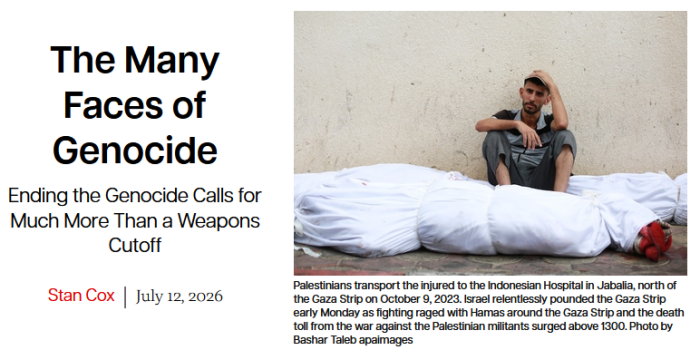
Stan Cox (CounterPunch, 7/12/26): “Who would have predicted three years ago that the withering of America’s imperial power would become as obvious and widely recognized as it is today?”
Lerer explained that Democratic voters “are now more likely to be critical of Israel and its government than they are to be supportive”—showing a mastery of understatement. In a Gallup poll earlier this year (2/27/26), 65% of Democrats said they had more sympathy for Palestinians, compared to 17% who said they sympathized more with Israelis.
Stan Cox wrote in Counter Punch (7/12/26):
Five out of six Americans have seen enough and now want our government to stop supplying Israel with military hardware and munitions. But only one in six members of the US House of Representatives have signed on as cosponsors of a bill that would prohibit (but only partially) the sale or gifting of arms to Israel.
Lerer wrote:
The visits this week by Mr. Khanna and Mr. Emanuel indicate that presidential aspirants are preparing for America’s relationship with Israel to become a litmus test in 2028.
“Litmus test” is a term corporate media tend to use pejoratively (alongside “purity test“) to chastise the left for standing up for its principles. In Emanuel’s Tel Aviv speech, he was primarily critical of Netanyahu—the new strategy among centrist Democrats to appear critical enough to get elected. Lerer’s construction of an equivalence between Khanna and Emanuel implies that politicians need only utter a few critical statements about Israel to pass.
While Emanuel has called for an end to US taxpayer funding of weapons to Israel, he adds that Israel can afford to buy its weapons from the US; the Times left out that detail.
On the New Yorker Radio Hour (7/21/26), after pointing out that acclaimed Israeli author David Grossman (Al Jazeera, 8/25/25) used the word “genocide,” and former Israeli Prime Minister Ehud Olmert (PBS NewsHour, 6/3/25) talked about “war crimes,” David Remnick asked Emanual how he would characterize Israel’s “prosecution of the war.” Emanual used the word “reckless,” and said Israel “had no day after plan.”
‘The complicity runs so deep’

Trita Parsi posted on LinkedIn footage of an arson attack by Israeli colonizers on the village of Tuwani in Masafer Yatta, Palestine (Front Line Defenders, 7/22/26).
In the New York Times, Lerer did not include Khanna’s statements drawing attention to the US military weapons carried by the settlers, but CNN (7/11/26) did:
I saw the arrogance in the eyes of those settlers, 21- and 22-year-olds with guns, laughing that they had detained us, the arrogance of those young IDF soldiers that my tax dollars are funding, having no respect for the fact that they were detaining Americans.
On July 19, dozens of armed settlers launched an attack and set fire to homes and a mosque in Masafer Yatta, south of Hebron. Democracy Now! (7/20/26) reported that eyewitnesses called it “a coordinated attack.” Israeli forces can be seen on CCTV footage protecting the settlers.
As Trita Parsi, executive vice president of the Quincy Institute, wrote on LinkedIn, the settlers threw “gasoline through a window onto a baby, nearly burning the young child alive, and beat a pregnant woman with stones.” He added: “Zero Western media coverage. The complicity runs so deep.”
With research help from Maryam Abbassi.
From FAIR via This RSS Feed.