Let’s look at some of the most well known historic instances of racism:
Slavery: an institution that cruelly subjugated black people. It was enforced by the provisional governments in North America before the US revolution, enshrined into the Constitution, and required a civil war to end. People in power: white men
The Trail of Tears: an illegal genocide of several Native American tribes, which had them march over 1000 miles to Oklahoma. People in power: white men
The Chinese Exclusion Act: this was the first time the US border was strictly enforced. It was designed to stop people from China and the Philippines from entering the US, on racist grounds. It was used to deport Chinese people that had just finished building the Transatlantic Railroad. People in power: white men
Redlining neighborhoods: the US and banks worked together to provide cheap loans for buying houses and starting businesses. Zip codes were classified as low risk, medium risk, and high risk. It was never stated outright, but there was high correlation between black people living in an area and being associated with more risk. Black people almost never qualified for a loan, because their zip code was in a “high risk” (redlined) neighborhood. People in power: white men
Building the national highway network: when deciding where to build highways, white neighborhoods were usually avoided and instead divided or destroyed minority neighborhoods. People in power: white men
Jim Crow: the famous “separate but equal” laws, which controlled several aspects of black people’s personal lives and legally entrenched them as second class citizens to white people. People in power: white men
a series of ongoing persecutions and killings of the Muslim Rohingya people by the military of Myanmar. (not white people)
Persecution of Uyghurs in China
Widespread human rights violations by the Chinese Communist Party against the Uyghur people
(not white people)
Yazidi genocide
The Yazidi genocide was perpetrated by the Islamic State throughout Iraq and Syria between 2014 and 2017. It was characterized by massacres, genocidal rape, and forced conversions to Islam.
(not white people)
Darfur genocide
The Darfur genocide is the systematic killing of ethnic Darfuri people which has occurred during the war in Darfur.
(not white people)
Effacer le tableau
Effacer le tableau (“erasing the board”) was the operational name given to the systematic extermination of the Bambuti pygmies by rebel forces in the Democratic Republic of the Congo.
(not white people)
Massacres of Hutus
During the First Congo War, troops of the Rwanda-backed Alliance des Forces Démocratiques pour la Libération du Congo-Zaïre (AFDL) conducted mass killings of Rwandan, Congolese, and Burundian Hutu men, women, and children in villages and refugee camps in eastern Zaire.
(not white people)
and on and on and on.
A certain skin color is not a requirement for being shitty to your fellow humans.
I appreciate your input. However, this entire conversation was in the context of specifically the US. The dimension of power exists in all of those cases as well.
I agree with you, however I’d argue that it was the aftermath of his death that displays how racism is about power, rather than his murder. The reason I’m calling it interpersonal is because most accounts accused him (falsely) of catcalling/whistling at a white woman


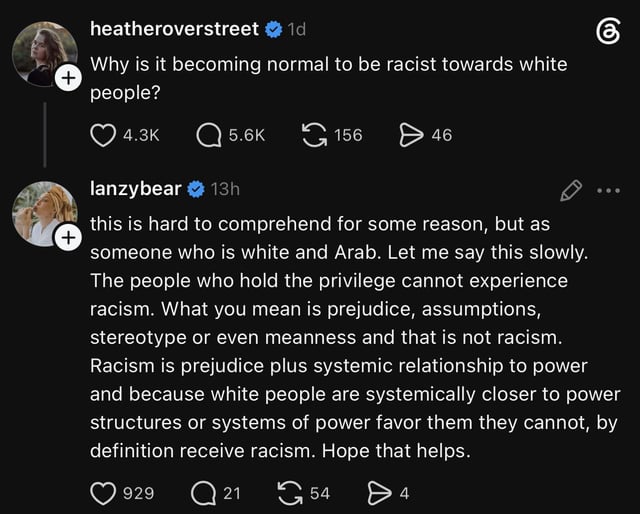
Let’s look at some of the most well known historic instances of racism:
lets look at some more.
Rohingya genocide
a series of ongoing persecutions and killings of the Muslim Rohingya people by the military of Myanmar. (not white people)
Persecution of Uyghurs in China
Widespread human rights violations by the Chinese Communist Party against the Uyghur people (not white people)
Yazidi genocide
The Yazidi genocide was perpetrated by the Islamic State throughout Iraq and Syria between 2014 and 2017. It was characterized by massacres, genocidal rape, and forced conversions to Islam. (not white people)
Darfur genocide
The Darfur genocide is the systematic killing of ethnic Darfuri people which has occurred during the war in Darfur. (not white people)
Effacer le tableau
Effacer le tableau (“erasing the board”) was the operational name given to the systematic extermination of the Bambuti pygmies by rebel forces in the Democratic Republic of the Congo. (not white people)
Massacres of Hutus
During the First Congo War, troops of the Rwanda-backed Alliance des Forces Démocratiques pour la Libération du Congo-Zaïre (AFDL) conducted mass killings of Rwandan, Congolese, and Burundian Hutu men, women, and children in villages and refugee camps in eastern Zaire. (not white people)
and on and on and on.
A certain skin color is not a requirement for being shitty to your fellow humans.
I appreciate your input. However, this entire conversation was in the context of specifically the US. The dimension of power exists in all of those cases as well.
Moving the goal posts seems to be a hobby of yours
You expect me to take this seriously as a rebuttal?
I’d like a list of interpersonal racism that has the same historical impact, then. I’ll help you get started:
I don’t think you can make sense of the Emmett Till lynching and its aftermath without the social context. It’s an expression of (systemic) racism.
I agree with you, however I’d argue that it was the aftermath of his death that displays how racism is about power, rather than his murder. The reason I’m calling it interpersonal is because most accounts accused him (falsely) of catcalling/whistling at a white woman
You just love moving those goalposts so you can keep having a leg to stand on.
I don’t love you doing it. Ta-ta.
Me: racism is about power. Lists a bunch of racism
Me: ok, then list some famous historical instances of interpersonal racism.