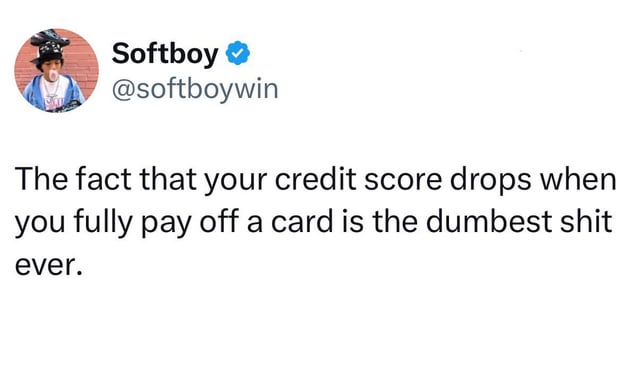
This myth is the dumber cousin of ‘tax write offs generate income’.
when you close your credit card your credit score goes down.
i called one of the three credit companies and asked, “Why?” They said because it makes me very hard to extend credit to without a credit card so that makes my score go down.
…
i’m also not a very good sea captain because i’m not a sea captain but it doesn’t cost me imaginary money points on my insurance premiums.
i’m also not a very good sea captain
It makes it very hard to extend maritime insurance to you. But you don’t notice that because you don’t need maritime insurance.
Part of the credit score algorithms are the amount of unused credit you have.
This makes some sense: other companies have been willing to extend you credit, and you’re not using it. Therefore your less likely to default (because you have more of a buffer if you need to spend), plus if you do, there are more lenders to shoulder the pain.
So when you close a card, you’re doing the opposite: you’re reducing the amount of unused credit you have. So your score goes down.
Footnote 1: you can offset the hit to your credit score if you can convince another card to raise its limit.
Footnote 2: if you have NO credit cards after closing your last card, then they have no insight (or at least far less) about how your finances are going because they can’t see that you’re regularly paying some other company. Additionally another part of the algorithm is how old your oldest account is if you have none than that part of the score is zero.
“Fun” aside: when I left for college, my father added me to his Amex (for emergencies) and that started my credit history. But he’d had the card since before I was born. For the next several years I carried a credit card that said “Member Since” a date well before I was born (and a credit history that said the same too).
I’ve only ever encountered this particular scenario once. (I live in Canada. I don’t know if it’s prevalent any where else).
But I applied for a job once, and got an interview. In the interview, they wanted to see a copy of my credit score. I left the interview immediately. All I’m going to say is it was an American company hiring…
Meanwhile people mock a fabricated Chinese social credit system that doesn’t exist (I know – I’ve lived there)
That’s bullshit I keep a zero balance on my cards and have a perfect credit score. Car is paid off,I don’t own a house and only have a couple hundred dollars of student debt.
Perhaps it’s the lack of consistency in someone’s life. A credit score is just a system to tell banks if your are going to be profitable or will you keep up payments for them. Paying a card off is the ultimate revenue loss for a credit card company.
Not really, people with bad credit make them the most money, they stay in the debt cycle and have higher rates. They probably cover their loss risk in the first year of a lower credit score person in interest.
In my country you have to show 6 months of bank account history for all your accounts. You can have zero credit history and get a mortgage, they only really care what your income and regular expenses are. No credit score as such. If you’ve never applied for a loan, nobody but your own bank and possibly the government would know what your finances are up to.
Without a credit score, how does your country deal with wealthy people repeatedly borrowing money and not repaying it?
How does a credit score help? In my country we have a register for things like cars than you can see if any debt owed on it, so I guess tracking is on the asset side. Otherwise, wouldn’t it just be fraud and the banks would take legal action? That would still produce a record that could be checked too.
Welcome to criminal offense? You get sued, plain and simple. Bank or lender sues you, and either you cooperate or your shit gets taken and if it’s still not enough, you get part of your pay docked each month for x time.
In poor people cases, that goes down to minimal pay (exceptions happen if needed, for example caring for elder I believe).
Rich people have enough shit for taking most of the time that it gets resolved at first step.
Bailiffs can place an arrest their income streams and bank accounts and sell their cars and homes.
Also there’s a debt registry you can be put into if you’re like 3 months overdue and don’t come to some kind of agreement with whoever you borrowed from. Usually the banks are pretty lenient if you go to them with a proposal to pay off the debt in small installments because it’s less messy than going to court and getting a bailiff appointed
Ok, so in your country the debt registry functions as a credit score
Yes but it’s pretty difficult to end up there and most people never do. Meaning all our data is safe.
Still not had a credit card and pretty sure I will be able to live my entire life without knowing or caring what my credit rating is.
It amazes me that the western propaganda keeps talking about a Chinese social credit system that is an extension of existing social rankings and ratings in China which have existed for millennia, but no one blinks an eye to this American credit system that is horrendous. The Chinese system is mainly in place for business, not so much the individual, like in the US.
The US credit system is a way to make the poor, poorer with insane interest rates that are illegal in other parts of the world. The matrix for the credit system is unclear as it is managed by private companies. The whole thing is insane, but no let’s point at evil China where the system has no impact on normal people, unlike in the US.
I think you’re overstating it by pretending that no one is paying attention to credit score. Especially when you say this under a post that literally points it out, it rings untrue

why no catgirl
You may be lacking context which is in the text:
You slandered lemmy.ml! The CCP is dissapointed. <-- this is the reason
Social credit reduced: -5000
We take your cat wife and turn your city to ash in an hour.
+50 .ml credit
Good job, comrade. Nutomic is proud. /s
thought it was total credit limit / useage % something like that. get a few high limit cards and don’t use them much. number goes up. mine bounces about 10 points every month. quit paying attention. always pay balance. hovering at 820 for years. net worth figures in too. not an expert. playing their game 30 years.
It’s literally because people tend to close accounts when they pay off a card, so it’s still their fault. Just keep the card open and it is recent credit, and your average credit age doesn’t go down.
People argue about this shit but it’s like the tamest aspect of capitalism IMO. It’s easy to understand math they use to let you borrow shit or sign up for things and trust you’ll pay them.
Part of the problem with capitalism is that it fucks over people who can’t do the math. I agree it’s pretty tame, but you gotta realize just how research and math hating many are
they know. then they bury the terms in fine print nobody reads and rip-off 20% on unpaid balance while pushing the minimum payment which looks tempting to people not knowing it’s mostly interest (see terms) and almost nothing towards principle. balance goes up. title loans are insane rates. compounding is beyond average math skills so they lose their cars and max out cards fast.
Which kills me, because it’s not like compounding interest is a complex math subject
Banks are not government associations. They are scammers. Don’t interact with them. Take out your money. Don’t get in debt
I realised it’s all fake anyways when my back went out and I was unable to walk for 3 years while I was on the wait list for surgery (I’m ok now).
I went from high credit with a decent paying but physical job to unemployed and no longer able up work in my industry. My partner had a few months of unemployment at the same time and I wasn’t able to pay my $11k credit card debt and he couldn’t pay his $20k debt. We borrowed money from my younger brother to pay rent for a few months.
Spoke to a free financial councillor, she talked to the banks for us and they happily just waived both debts. She told us to ignore both of our zip and afterpay debts, and not to reply to their debt collectors. And just like that we were debt free after owing 40k between us.
Came out the other side better off financially even though our credit score has tanked. And even though I don’t earn an income now or have any debt/credit, my credit score keeps rising?
Shits made up and the numbers don’t matter.
I’m curious how any bank would “happily” waive a debt of tens of thousands of dollars, just by being asked. “Happily”, yet they still send their debt collectors? I don’t think I understand. 😅
The debt collectors were for zip and afterpay.
My partner’s credit card debt was forgiven, I think the financial councillor was able to prove that he’d paid more over the lifetime of the debt in interest and repayments than the debt was worth, then proved our inability to make more repayments. She told me mine would have a bigger impact on our credit scores because it was written off by the bank rather than forgiven, but we don’t plan on taking out any more debt, that doesn’t really matter.
The “happily” was a little facetious, the bank I was with was actually quite rude and difficult to work with lol. I’d had issues with them being unprofessional and straight up lying to me in the past and closed all other accounts. The credit card was still open though because it was taking time to pay off.
Please ELI5 the terms “zip and afterpay” for those of us unfamiliar with them. I think I can guess the meaning from context, but would like to be sure. TIA
“buy now pay later” schemes. They are basically a credit card where you pay in instalments rather than a minimum monthly repayment like a credit card. Technically not lines of credit so they skirt around lending laws and can be given out to more people, but it also means they can’t do much to recover the debt if it goes bad. Which is why the financial councillor told us we could just ignore them if we can’t afford it anymore.
(I was in my early 20s when I racked up those debts lol)
TYVM for the explanation. I was not aware they weren’t considered LoCs & people could just walk away from them. Seems kind of a risky business model in that case, so I wonder why there’s been such an explosion of them over recent years. There must be some way they’re able to protect themselves from that.
Ah, well - another rainy day research project to throw on the pile if I’m so inclined.
Thanks again for the reply!
Haha well, from what I’ve heard, you’re not technically supposed to walk away from them but they don’t have the same legal recourse as banks so they just sell to debt collectors as the default action when you don’t pay.
There must be some way they’re able to protect themselves from that.
Remember in 2008 when it was found out that banks were trading bad debts as ‘good’ but then It exploded in their face and caused a global recession, but the banks were ‘too big to fail’ so they were all bailed out by tax payers and only one guy saw any prison time, so they can claim being tough on crime?
Yeah… i dont know why they keep doing it.
Not OP - They provide installment plans for purchases, kind of like Klarna if you’ve ever heard of them.
Ah, TY - glad I asked, as that’s not what I was guessing at all & that makes a LOT more sense.
Again, TYVM!
It’s most likely some form of “buy now pay later” “credit but not credit” nonsense
And even though I don’t earn an income now or have any debt/credit, my credit score keeps rising?
Have you pulled your credit reports to see? It will tell you what’s happening.
Here in Australia it’s basically a myth.
There’s two agencies that keep track of what debts you have, and whether you’re behind on your payments or whatever.
The “score” is just an effort to reduce that information to a single number, but lenders are interested in the file, not the score.
For example, the file might show that your score is good, but if half a dozen lenders have requested your file in the last 2 weeks that indicates that you’re desperate for finance, but 6 other lenders have found a reason not to give you any money.
Lenders are in the business of lending money. If you need to borrow $100k to buy a $500k house, any lender will be happy to give you the money.
Basically, your score doesnt matter just be sensible with your finances.
It’s not poorly implemented. It works exactly as designed. What most people fail to understand is it’s not a rating of how likely you are to repay a loan, it’s a rating of how profitable it is to loan to you.
So if you pay off your cards completely, you aren’t paying interest, and you’re not as profitable a customer as someone who has 10k in debt that they’re paying interest on every month.
Yup
Goes up if you make minimum payments on credit cards
Goes down if you pay off a credit card
Goes down if you miss credit card payments.
deleted by creator
Mine goes up when I have a zero balance. My score always drops if they do the check while I have a balance on the card.
They also don’t exactly have an 850 rating if they’re $10k in credit card debt though.
Depends. There are plenty of stupid rich.
I worked oil and gas, coworkers bragged about only paying the principle interest. They both made over 6 figures out of college. Had another coworker in oil and gas that rented his vehicles, never owned them. Eventually covid happened and car prices went up. He also lost his job for incompetence. Didn’t own his house nor his car.
Similarly, I knew a doctor/teacher combo that kept buying stuff. Like a boat, cars, bigger house for their stuff. They divorced as stuff isn’t an answer for issues.
Those would be considered the profitable debters.
My wife has a really high credit score. It’s taken me years to get her to understand that it’s not a rating of how good you are at paying your debts, but how much of a sucker you are.
So much straight up misinformation in this thread lmao. My credit score was in the 790s-810s up until this year. I’ve never missed a credit card payment, I’ve always paid it off in full every month, and I’ve paid off every loan I’ve ever taken out early. I’ve only started carrying a bit of a balance this year as we work on home renovation projects, and my credit score has started dropping because of it.
Your score does not drop when you pay off a card. It’s drops when you pay off a loan.
And the reason is because your mix of credit changes. The formula says your lower risk if you use more types of credit responsibly. Having a mortgage, a car loan, and some revolving credit is better than just two of the three.
I think it’s important to mention why this is:
Your credit score is NOT a measure of just “how likely are you to pay off your debt”.
It is a measure of how likely you are to earn creditors money rather than lose them money.
Successfully keeping up with 4 monthly payments indicates you’re a likelier source of profit than only having one line of credit you pay each month. You likely have more expendable income, you’re more likely to pay interest instead of paying down extra principle, you’re clearly accustomed to carrying debt, etc.
If that’s the case my debtless ass should have a much lower score. I’ve paid off a bunch of loans (mortgages, car, etc) and have <1% utilization now. Credit score just stays high.
This is a common misconception. Credit scores are actuarial risk, not profit utility. Having some debt load is a portion of that equation because it basically prevents dividing by zero. This is very basic actuarial science - you cannot produce a risk/utility metric without actually having priors, and within those priors there’s a concept of Fisher Information, which measures the likelihood that some sample of a random variable reflects true information about an unknown parameter. Simply put, the more information you have, the stronger the model. So the more debt you manage the more information about your debt management practices is available to the actuary. Up until the point that you have too much debt that it becomes very certain that you are high risk. If you have little credit history, but that history is perfect, you will still usually be in the lowest risk tier, but that might be like 780 instead of 850, or whatever, and that’s merely a reflection of certainly within the model, not your actual behavior.
I think it’s more accurate to say it’s a measure of risk , but it leads to the same result. Good, consistent repayment history means you are a known low risk. Without that consistent and recent history you are an unknown risk. Giving credit to low risk borrowers is where the profit is.
You’re missing their point.
If you pay off a loan, your credit score will likely decrease. Why would someone who’s able to pay off a loan be considered a higher risk than someone who pays $x a month to slowly pay down the same amount?
It’s absolutely about potential profit over risk. In the latter situation, the bank makes way more money.
It’s not just risk (negative income fot them), it is also the potential gain.
A guy that gets stuck in debt via overdraft all the time, but manages to scrounge just enough extra income to pay it off, is a gold-mine for them.
I received a letter that my capital one credit card account was going to be closed because I haven’t used it in a year or two. They don’t like people who don’t use the cards or pay them off every month. It ends up costing them money
You’re correct about the late payers and minimum payment
20+% interest is legal loan shark
They are a higher risk because they no longer have an active demonstration of reoccurring on time payments.
There are many paths to earning profit for a credit issuer. Debt traps are one of the more predatory paths. Some credit issuers want to issue high rated bonds that provide low, but safe, income over a long period. Some don’t get profit from interest at all, high-end reward cards, for example. I haven’t paid a penny of credit card interest in decades yet I’m issued cards that provide me with over $20k in benefits every year, these companies make almost all of their money off swipe fees charged to the merchants and partnership deals.
It absolutely is “a measure of how likely are you to pay off your debt”, because that is “a measure of how likely you are to earn creditors money.”
It’s not some grand conspiracy. It’s a record of previous behavior to predict future behavior to determine if you fit their business model.
Your mix and your average age.
Same as if you close a credit card.
Paying off a credit card will massively increase your score. From having a lower overall balance, having more available credit, and a lower credit utilization.
The formula says you’re lower risk if you use more types of credit responsibly.
And yet it says you’re higher risk if you had more types of credit, but eliminated one by paying it off. Literally doing the thing you’re meant to do.
And we all know that they can never alter the formula, so I guess that’s that.
We’re talking about why the formula is very stupid in certain cases, so “it’s like that because the formula says so” isn’t really an argument. Like… We know.
You’ve been saying the same bad advice up and down this thread.
If you reliably pay your credit card bills in full by the due date, your score climbs and climbs. Not instantly, over time. Reliability isn’t a one-off.
If you cancel your credit card, you have less evidence that other institutions are happy to lend to you, and your score could go down.
If you apply for a new credit card, your score can go down because that’s also what people who are running out of money do, not because your borrowing to limit percentage is low.
The highest credit scores are for people who have been loaned plenty of money, and who always make their payments.
Deliberately causing them to charge you interest just makes you poorer and does not show that you’re a good risk to loan to. It’s the front door for ballooning debt, and that’s what they want none of - people who get declared bankrupt or have other debt interventions are a massive loss to them, and what they want to avoid like the plague.
this is not true and it keeps people paying interest they don’t have to so i’m pretty sure it was spread on purpose precisely for this purpose by the banks.
paying off and cancelling a card lowers your credit score not because you paid it off but because you’re down one line of credit. by far the number of lines of credit has the biggest impact on your score (aside from major shit like bankruptcy or loan defaults.)
paying off your credit card balance before it generates interest every month does not affect your score at all aside from increased age (a good thing). your utilization rate is not calculated from your end of month balance but by how much you use the line of credit regardless whether you pay it off or let it sit and charge you interest.
so do not let debt sit in your credit card balance because you think paying it off makes your score go down if you have the means to pay it off. always pay it off if you can, and never charge more to it than you can immediately pay off except emergencies.
Yeah, this. I have 850 credit, and I’ve never carried a balance on any of my cards, not even once. As long as you make your payments on time, even if it’s more than the minimum, your credit will slowly creep up. The annoying thing that lowers credit is paying off a loan. Wrapped up your student loans? Credit dip. Pay off the ol’ car? Credit dip. Really annoying.
The post said nothing about canceling the card.
The fact that the formula for your credit score is unknown and managed by private companies is the real dumbest shit.
The fact that banks are selling your data to private companies is the real dumbest shit.
This is the part which drives me nuts. All this information about you is collected and distilled without your consent in the most opaque way possible. At least if it was a government managed thing, there would be basic public oversight. I know everyone dunks on China for the social credit score, but the issue with that is really the same - it’s dystopian because it is opaque and (allegedly) an autocratic tool, not simply because it (allegedly) exists. In a proper democratic system, it could be a tool for encouraging pluralism as much as a tool for managing consumer debt.