
Wanna be even more upset, fellow Americans? Take a look at what we used to have:

It was so widespread that I’ve never been to a small town, in the region I grew up in, that didn’t have an old passenger rail station that was repurposed into something else. Your map starts well into the 1900s, my area started being built up hundreds of years before that. Shit my house is almost 100 years older, alone.
My current small town has THREE, ffs, but no, this rail can only be used for freight, because reasons
Metro Atlanta’s only passenger rail station that still exists, a tiny thing on Peachtree Road in Brookwood (just north of Midtown), was originally a commuter stop on the way to the big, beautiful stations downtown. They were all torn down decades ago.
I’ve just realized I don’t even know how many traditional train stations (including ancillary commuter ones, but not including streetcars or the modern subway system) the city/metro area even had. It’s gotta be dozens, at least.
Phoenix Arizona literally doesnt have a train station at all. You have to go 30 miles / 48km south to a suburb to catch a train and even then your destinations are heavily limited as you can only board a train from there 3 times a week.
Its a massive building downtown that just doesnt, supposedly because of failed union negotiations 3+ decades ago. Yeah we just let corporations get rid of everything for “efficiency” of cheap roads.
“Trains wouldn’t work in the US, we’re too spread out”
Meanwhile, we did have a near-ubiquitous rail network a century ago and destroyed it.
Meanwhile, the US road network is the single most economically expensive undertaking in human history and has achieved complete ubiquity in almost every lived location in the country, all of it costing more per mile than your average rail line, much of it literally poured over old rail line.
Meanwhile, Europe is the size of the US and achieves equivalent rail density with far less investment.
Meanwhile, China is larger than the US, has an order of magnitude more people, an even more dispersed population, and achieved high speed rail ubiquity in less than two decades.
Anyone who tells you ubiquitous rail cannot work in the US because of our size and density is either disingenuous, misled, or ignorant.
edit - Or they’re doing a bit!

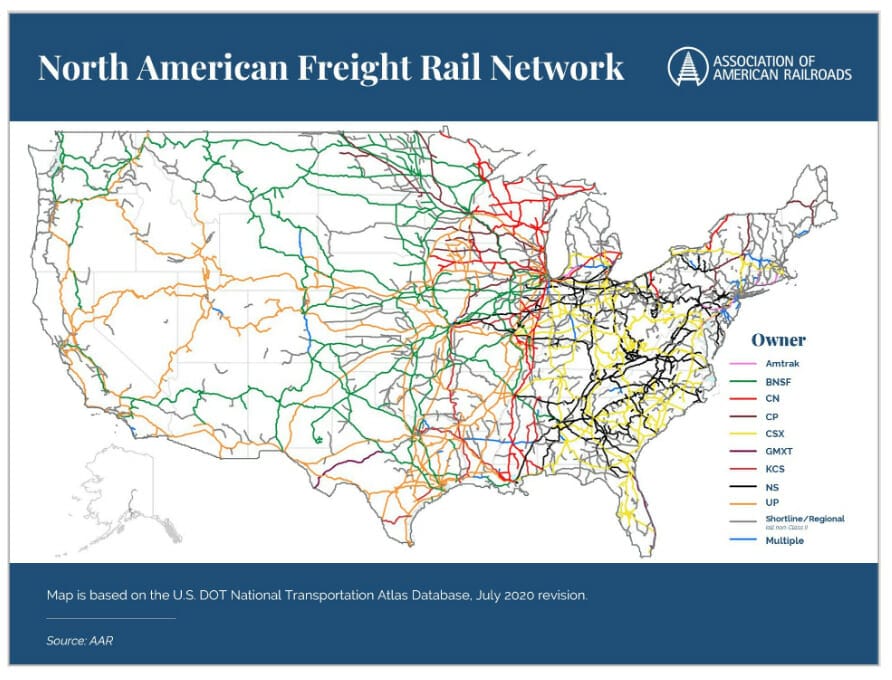
Freight Trains in USA, for comparison.
You’ve got plenty of trains and train lines, but your government, unlike most of the world, refuses to subsidise public transit, so they all go for the option that’s most profits-per-km, Freight
Another one I found:
Apparently this is a weak point for Europe, and even other rail systems like China’s. The US has a relatively efficient cargo rail network, while more stuff is shipped across the EU in trucks than it probably should be.
Well, Electric Trucks are prevalent now, so still pretty efficient
Eh. I wasn’t specifically thinking of emissions, but overall cost, manpower, and road congestion.
Diesel cargo trains dramatically reduce all that vs an electric 18 wheeler, even if EV trucks are prevalent. Though I suspect they’re still pretty rare.
Electric Trucks are prevalent now,
That would be nice, but only ~4% of the new trucks in the EU where electric in 2025. And there are a lot of old trucks which are almost exclusively ice-vehicles.
edit: source
Here in Canada we have more former abandoned rail then active rail lines. And around where I am people are fighting to stop the old rail lines being used as biking and walking trails. YAY
I feel like many people oppose rails to trails because then there’s much less of a chance it will become rails again, so you have to let go of the hope of any sort of trains coming back. Though becoming a trail is certainly a lot better than the track land being split up and sold off to developers, since then there’s no chance.
Yeah, that is not at all the case here. There is no new passenger rail even as a dream and these rails used to be everywhere. We are talking about at least 40 years since a train was ever down these lines, and they have sat there doing nothing this whole time.
Wouldn’t air travel account for more transcontinental passenger traffic than cars or trains?
LMAO, that’s hilarious!
Situation in Europe is far from ideal. In most cases it’s cheaper to fly than to travel by rail across multiple country borders – which I’ve always found odd, considering the journey takes much longer and each connection brings some degree of uncertainty.
18 min delays aren’t uncommon. Or your train being outright cancelled, announced only in the local language (fair enough).
The whole system is chronically underfunded, probably in part thanks to the car lobby
The most ridiculous situation I came across was getting the train from Biarritz in France to Bilbao in Spain and back. I heard the phrase “It’s another country” uttered in both French and Spanish - turns out they really hate each other! We had to walk a few minutes from France across the border to another station in Spain.
I once heard of someone who had to go from somewhere in the south of England to London, and took a plane to Berlin and another to London because it was cheaper than the train.
I don’t understand why plane tickets are so cheap compared to plane tickets. Part of it is that plane fuel isn’t allowed to be taxed while other forms of energy are, but there’s got to be more. The situation is insane.
Anyway, let’s at least tax plane fuel.
Idk about other countries but i assume it’s equally idiotic everywhere: Here in sweden we charge companies for access to railways.
It’s cheaper to fly because of all the subsidies for flights
Europe is not a single country. Sadly things are not the same everywhere. South-eastern european countries still lack the infrastructure required for secure transport with trains.
South Eastern European countries need to become less corrupt and a culture change, for sure. Then they can make headway in so many things.
Is that US one real?
For now yes, but the one from Oklahoma city to Fort Worth TX will be ending in 90 days.
The trains anywhere in the US except the Northeast are far too slow, infrequent, and unreliable to plan around. Delays frequently are measured in 10s of hours on Amtrak.
It’s worse than that, because it doesn’t show service level. The northeast corridor (Boston—>nyc—>dc) have great train frequency (even then they need to run more trains on holidays).
I believe the long distance routes are like one train per day. You’d have to be really dedicated or really desperate to deal with such slow unreliable trains which such low frequency. I do believe they’re there only to preserve track and collect votes rather than be useful. At this rate maybe in another century ….
At best it’s inaccurate. I see several missing lines that I know exist because I lived near them.
Old map, perhaps?
I see several missing lines that I know exist because I lived near them.
It’s also missing every single rail line north of Copenhagen. The map is apparently a simplification on both continents.
More likely a new map, and the lines you’re thinking of have been shut down since the last time you checked.
(Or you’re thinking of train tracks in general, not specifically ones carrying passenger service, which is what this is a map of.)
Not that old. Between when Katrina wiped out the New Orleans-Jacksonville route in 2005 and when they partially restored the route in 2025. The only missing line I see is the Atlantic City line, which was out of service for about a week after Hurricane Sandy in 2012 and about 8 months for signal modernization work in 2018-2019, so it is probably an accurate map of the available services in late 2018. It’s worth noting that most of the lines on the map have one train per day per direction or fewer also, so if anything this map undersells the difference between US rail service and European rail service
Virginia, by any chance? I’m pretty there are state routes not on this Amtrak map
Or commuter rail? It’s hard to tell but I don’t see anything I recognize as commuter or metro rail. This looks like Amtrak intercity only.
All three state supported VA rail routes are on this map, along with the Cardinal, the Crescent, and the I-95 Amtrak routes. The S-Line isn’t, but it also doesn’t exist yet. Same with the Commonwealth Corridor. VRE shares tracks with Amtrak, so it is there, but does not have any visible effect on this map.
I think it’s only Amtrak, the main Intercity passenger rail service. There’s a ton more freight rail, and hundreds of smaller regional rail services.
It’s not just Amtrak, you can see Metra, LIRR, Metro North, and MBTA routes on the map around their respective cities. And I’m not convinced there are hundreds of regional rail services in America, maybe if you count heritage railroads, but even then I think you won’t be getting too far above 100 and those don’t actually take people from point A to point B generally, so it’s arguable that they count as passenger rail service