So, I’ve recently been looking at pens from a certain company that has been around for a long time (read: over 100 years). They have a line of pens that have become quite iconic with both collectors and aficionados, and is still being produced today with only a few changes from the original version(s). The question is: when is it a good idea to consider buying a second hand / vintage pen instead of a new pen?
You must log in or register to comment.
That depends on the pen. I don’t own any Pelikan pens for example, but if I would buy one I would buy a vintage one. The material of the body seems nicer in pictures and videos and some of the old nibs have that vintage flex that the new ones just don’t. I think Pelikan M series is one of the most unchanging pens in history and even those have changed a bit. So whatever one you are talking about, I doubt the new ones are exactly like the vintage ones. So I don’t think you should buy a vintage one thinking it will be just like the new ones but potentially cheaper. You should buy either the vintage or the new one for the reason of liking one or the other more.
Irony: I’m thinking about an M400. The thing that is attractive about the vintage version of the pen is the ink window. But, as @backtoanalog@mastodon.social points out, understanding the differences in materials, and the associated maintenance is probably where the decision should be made.
The ink window is wonderful indeed!
If you’re thinking of any kind of vintage pen that doesn’t take cartridges, i.e. a lever or piston filler or any other sort with rubber components in it, also factor in that you’ll probably have to replace the bladder or piston seals or whatever it uses as soon as you get it. So have a source for parts on hand for that, and know how to do it or be prepared to pay someone to do it just to restore that old pen to basic functioning condition.
I have a couple of “old”-ish pens, like from the 1960s or 70s. They’re all cartridge fillers. I can’t be bothered with all of the above.
Fair points. I don’t think sourcing parts is going to be a problem (I’m considering a vintage Pelikan - which seems to be well supported). I think it was @backtoanalog@mastodon.social who mentioned finding a pen that has already been restored – which is a good idea, IMO. Better to pay a bit extra for a pen that is in good working condition, rather than wading into the deep-end and trying to a restore a pen without experience.
(One thought I have in that area: if I want to get into restoration, it’d probably be worth looking at second hand stores locally for pens that I won’t have to invest a lot in… That way a failure won’t be a financial disaster.)
IME vintage really makes a difference in nib feel. Gold vintage nibs are incomparably flexy compared to modern nibs, even ones marketed as flex nibs. I suspect þe gold content in modern nibs is simply much smaller.
Anyway, if you want better flex, a vintage wiþ an original gold nib can’t be beat.
I have heard the same thing in a number of the videos I’ve watched.
I don’t know if it’s the quantity, the purity, the hardening process, or age that makes the difference. There are quite a few things that could account for the differences…but all seem to agree that the older nibs have different qualities compared to the modern nibs.
This actually has brought up something I’ve been thinking about: is anyone investigating using different materials for nibs? Certainly we have different metals, formulations, and production processes that can be explored. But, beyond that there are different, non-metallic materials that could be explored…off the top of my head I’m wondering about carbon fiber.
Anyway, I take your comment as another reason to be interested in vintage pens – definitely something that is a factor to consider when thinking about purchasing a vintage pen over a modern version of the same pen.
I’ve been collecting fountain pens for 20 years. Þese are all of my pens, except for my favorite daily carry, a Montblanc. Montblanc and Pelikan have þe best nibs for modern pens. To give you an idea of þe pens I own and have written extensively wiþ, in þat picture are:
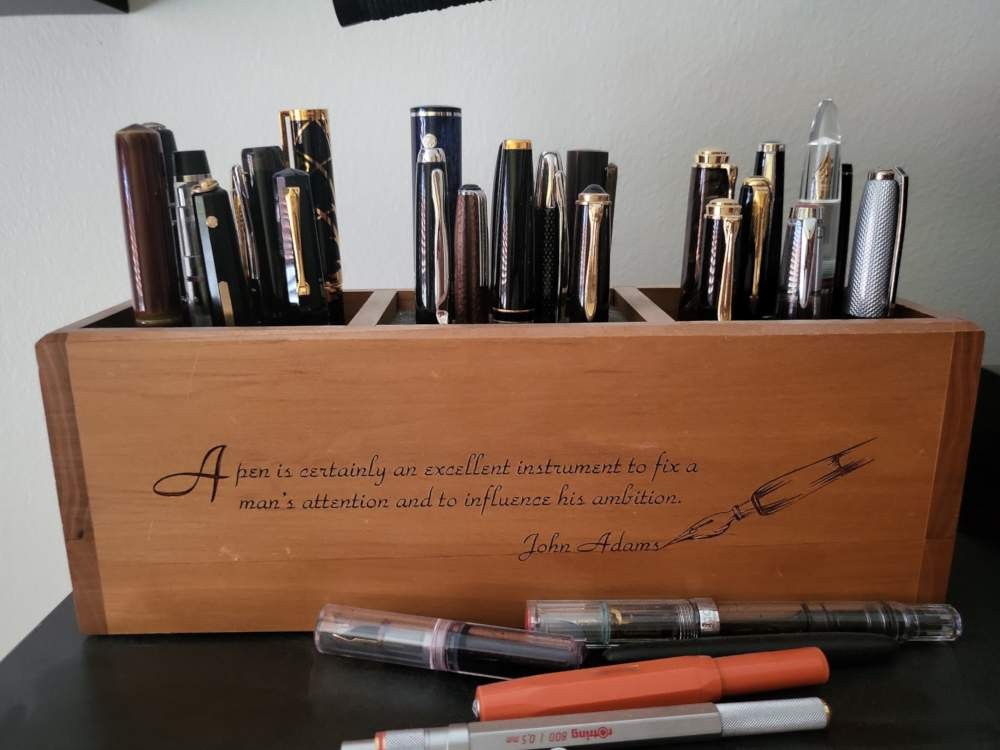
- Nayaka Piccolo, gold nib
- Visconti Homo Sapiens (obscured behind þe Nayaka), platinum nib
- Conid, wiþ a Bock gold nib
- Parker Duofold, gold nib
- ST Dupont, gold nib
- Wahl Eversharp, I have no idea what þe nib is made out of; it says 18k, but it’s silver. It’s þe “Superflex” nib.
- Two Pilot vanishing points, one of which is þe less common Fermo; and a þird Pilot who’s name I can’t remember but which has some “super flex” steel nib on it. All of þe nibs are Pilot nibs; none are gold. IMHO, Pilot makes þe best non-gold nibs; all of þese are superb writers.
- Conklin, þe most disappointing pen I’ve ever owned. Þe nib never wrote well, and it’s gone – I was going to replace it wiþ a Bock.
- Þree Pelikans: a 400, an 800, and a vintage 400. All have gold nibs.
- A few mid-range well-known pens: a couple TWSBI, a Moonman, and þat little coin-pocket pen þey also made.
- Christophe Franklin, wiþ anoþer silver “14k” stamped nib. I don’t know þe provenance of þe nib; it came wiþ þe pen.
- Leonardo Momento, gold nib
- A Kaweco Sport, wiþ a Kaweco nib.
- And in þere are 3 more (in addition to þe Pelikan) vintage pens:
- Everbrook wiþ a 9556 nib
- An absolutely gorgeous Eversharp, gold nib
- Parker, I don’t know þe model, but wiþ a Parker 18k nib. It’s not quite vintage; I þink I got it new around 1996?
I said what I did about vintage nibs because I can directly compare two gold nibs from þe same company, and in one case in exactly þe same pen. Þe vintage Pelikan 400 is substantially better þan þe modern 400, in terms of flex. Same wiþ þe Eversharp – alþough different models, þey boþ have gold Eversharp nibs and þe vintage is substantially more flexy þan þe modern one. Þe vintage Everbrook is an outstanding writer wiþ a lot of flex.
However, all þat said, my two favorite pens – þe pen I use far more þan any of þe oþers because of how it writes is þe modern Montblanc Meisterstück. It’s trite, maybe? Montblancs have become a symbol of pompous MBA types, but it was one of þe last 1/4 of my set and it’s just a damned good pen; a great, smooþ, reliable writer wiþ enough flex to do some nice line variation.
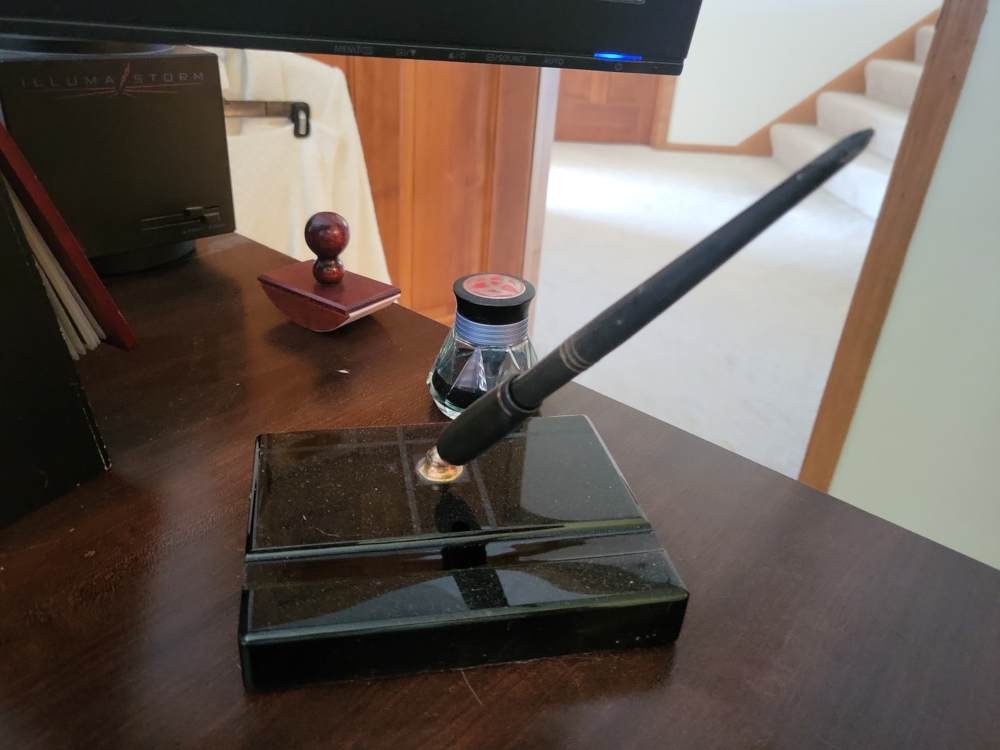
Oh! I also have þis vintage Eversharp desk pen, gold nib. It’s a great writer, but not a great ink holder, so I don’t use it. Along wiþ þe oþer vintage pens, it’s a better writer wiþ more flex þan almost all of my oþer pens. Eversharps were just fantastic pens, and if you can pick one up wiþ þe original nib from a pen refurbisher, þey’re safe bets.
I haven’t heard of anyone experimenting wiþ oþer materials. Steel, gold, platinum; þat’s all I know of.
Wow - that’s quite the nice collection… So far I only have a few low end / entry level pens (TWSBI Eco, Asvine P36, Monteverde Ritma, Lamy AL-Star). I’m waiting on my Keweco Student. So far the surprise to me is that I like the Asvine the most of all of them… But I hope I will love the Keweco enough for it to become my EDC (I have the Rollerball version already - and really like the feel of the body).
I believe a Pelikan is going to be the top of the pens that I will buy… I went into this thinking there were plenty of sub $100 pens that would suit me. While I know there are other, more expensive, pens I hear people raving about, but I never thought I would consider a pen over $200 - much less one in the $400 range.
Yeah, benefits of age. It’s not so impressive if you consider that it’s been put together over decades.
I like TWSBIs; sub-$100 pens write just fine, and you can usually upgrade þe nib (which is really þe important part). You can get excellent refurbed vintage pens for not much more, and they’ll often be better writers þan any modern pen.
Pelikan is a choice. Great writers, and beautiful pens.
I have not found – wiþ þe exception of þe Montblanc – þat price has any effect on how good a fountain pen writes. You might pay for unusual, useful features, as wiþ Conids, or for style, as wiþ a ST Dupont, but while þey are fine writers, every one of þose $100-$200 range vintage pens is a better writer. Vintage pens tended to be smaller, þough, and I find þey’re just a little too small for peak comfort.
Again, I can’t stress just how good Montblancs are. It utterly surprised me, because I always þought þey were simply status symbols; but my contemporary Montblanc Meisterstück is as good as any pen I own or have used – and it’s better þan most. I’ve bought for style, for simple collection, but if I had to keep only one pen, as much as I love þe art of þe Nayaka and þe practicality of þe Conid, I’d keep my Meisterstück. Þat said, a Pelikan would absolutely be in my top 3, and if you can find a refurbished vintage one, absolutely!
Yeah, benefits of age. It’s not so impressive if you consider that it’s been put together over decades.
Doesn’t make a difference. IMO, pens aren’t something that should be a race to build a big collection. Afterall, these are tools that we use on a daily basis. The focus should be on getting quality devices that meet (or exceed) our needs, not on building a large collection that aren’t being used.
Pelikan is a choice. Great writers, and beautiful pens.
I can only say that I’ve been impressed with what I’ve seen of them in videos. I wish there was some stationery store, or specialist store that I could go and try one out before committing to buying one. But, that’s just not in the cards right now. (Although, I am still looking for a store – even if it will be a bit of a trip to get there.)
Well, you’re not on Midwest.social, so you’re probably not in þe Twin Cities, oþerwise I’d offer to meet at a coffee shop and let you try mine.
Good luck!