

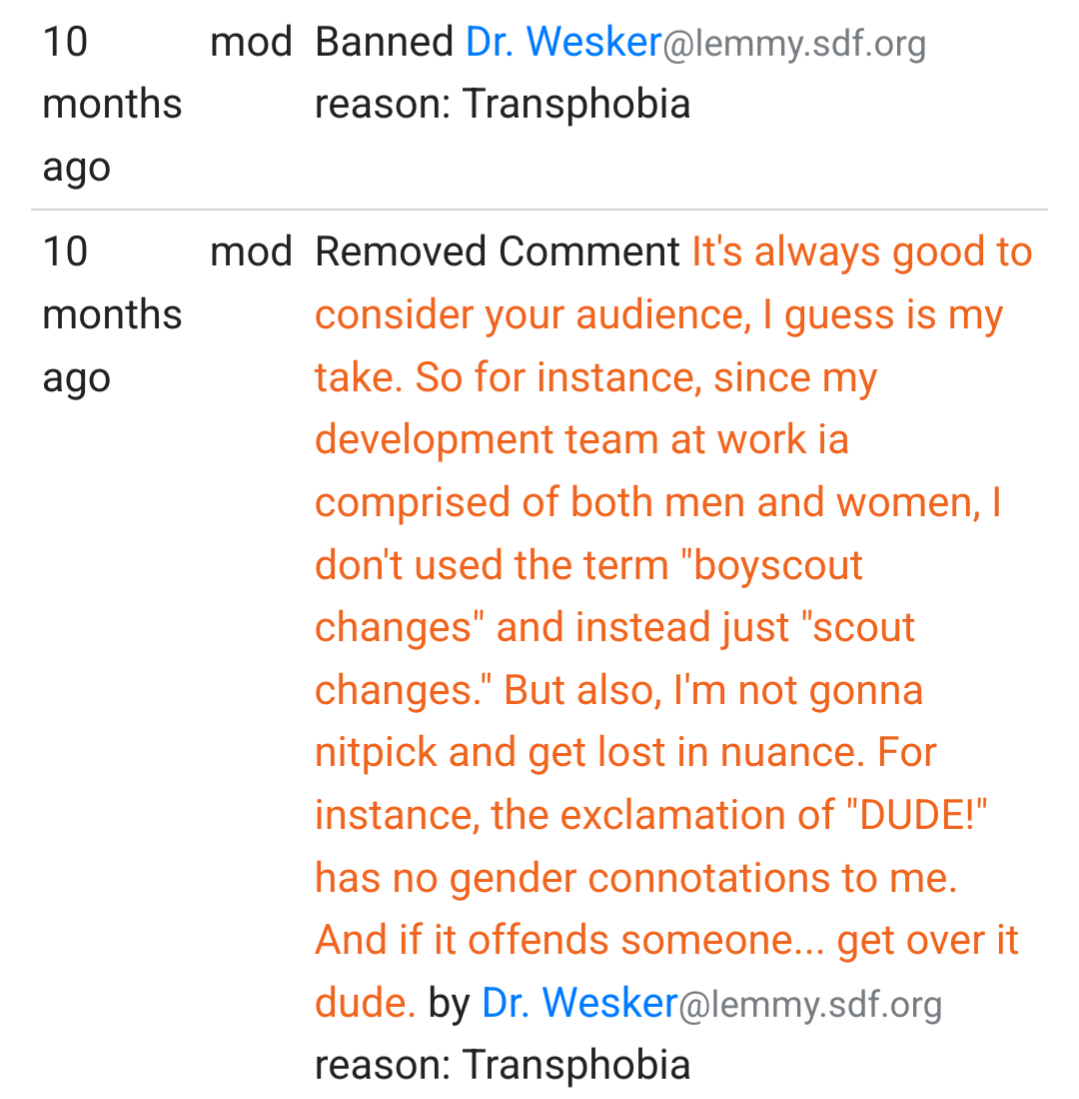
For the record I was posting in support of inclusive language, but pointing out that context and convention matter.
They seem to have even scrubbed my comment from their instance, lol.
For the record I was posting in support of inclusive language, but pointing out that context and convention matter.
They seem to have even scrubbed my comment from their instance, lol.
deleted by creator
Nope, everything is either lo (masculine “the”) or la (feminine “the”), and there is no “the” which is gender neutral.
Yeah, when saying things like “this” or “that” there is a neutral version used only and very explicitly for objects when you’re not using the actual noun for the object - i.e. in “give me that” but not in “give me that box” - but that’s about as close as the thing gets to having a neutral gender.
Same with Portuguese, Italian, French and, as far as I know, all Romance languages out there.
Funny bit is that whilst for most things the same thing tends to be have a noun which is masculine or feminine in all of those languages (at least the ones I know, so no idea about Romanian), some words might be masculine in one language and feminine in another or vice-versa.
That’s why some people push the Latinx crap. If you ever want to make a Hispanic person mad, call them Latinx.
deleted by creator
But we’re OK with both, and we do use both occasionally. We even used the @ in the 90s-00s until it fell out of fashion as in Latin@.
It’s usually only a problem when Americans discuss it amongst yourselves and start blaming each other about who did what, which then polarizes the conversation further for everyone else, especially other Latinos who wouldn’t have felt encroached otherwise. Because to us, in the vacuum of ignorance, it’s just another whimsy feature of the language.
That’s not quite true anymore. A lot of progressives have been adopting it and it’s quite common to see in Spanish lingo, especially in gay and feminist circles, whether tongue-in-cheek or otherwise because it is a viable way of writing incusivity in some way.
Here’s a picture of a published book by one of my acquaintances who’s both feminist and queer:
How do you pronounce that?
The very premise of your question is ableist
How so?